
Beyond solutions
there’s ideas
Sines Connected to the World: Data, AI and Creativity
What can I build with this data?
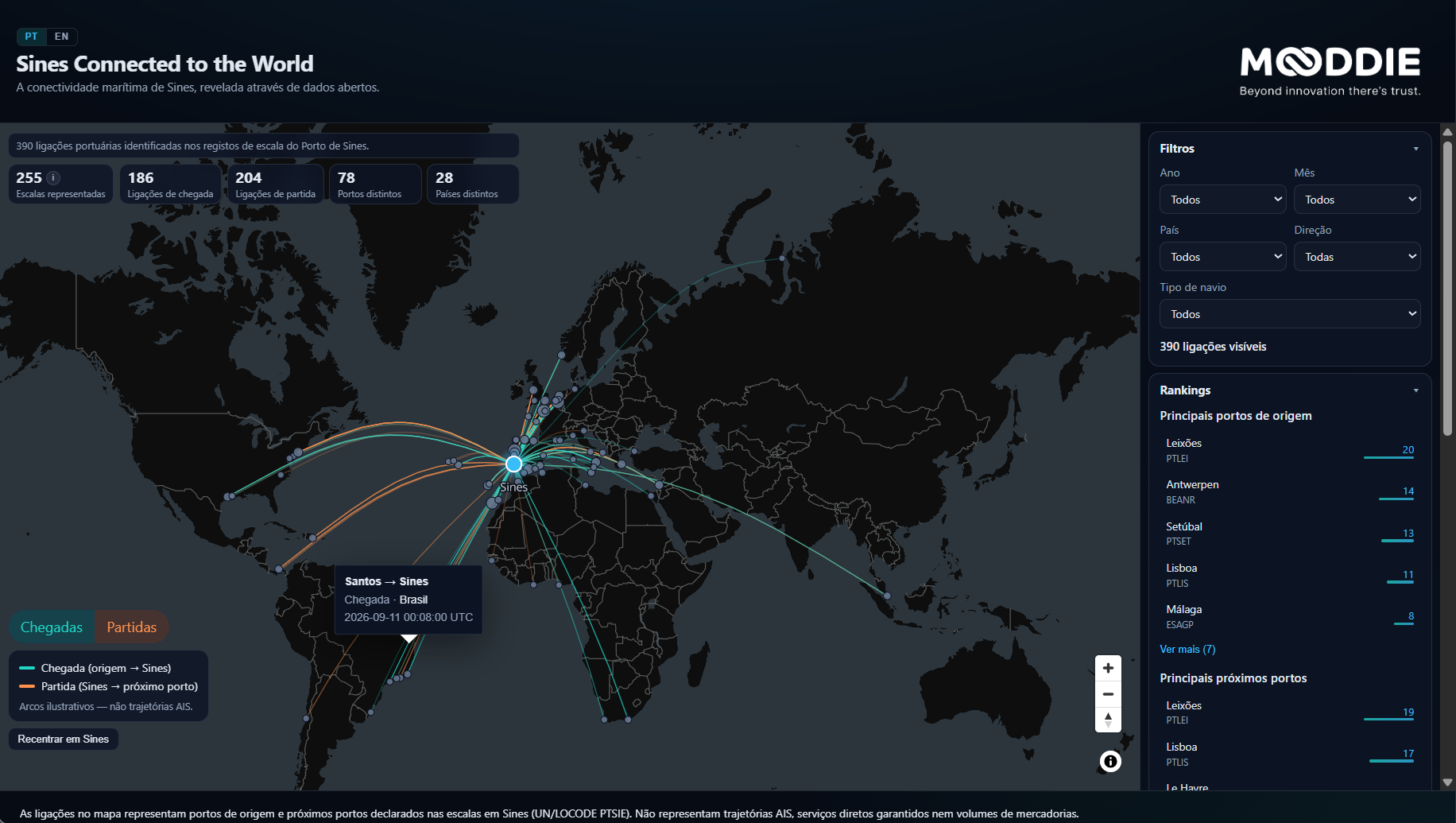
Sines Connected to the World started with a question. With the OpenSyllo API and the publicly available datasets, what can I build?
I started experimenting. Connecting information. Giving shape to what I had in mind.
During development, more questions emerged. And more ideas. Some came when I started looking at the data. Others when I tried to present the results.
That is one of the things I enjoy most about this process. I start with an idea and, along the way, discover possibilities I had not considered.
The result is a proof of concept. It is not ready for production yet. There are technical issues to resolve. Scaling and Big Data challenges to address. The user experience also needs improvement.
But it already shows that it is possible to explore open data and find value.
This is where I see the importance of platforms like OpenSyllo. Access to data that has already been processed and cleaned gives us a starting point for experimentation.
It is an opportunity for academia. And for a new generation of technical professionals.
They can practise a programming language using real data. Compare approaches. Create benchmarks. Learn while looking for answers to a specific question.
For data engineers, there is room to imagine new ways of combining datasets. Explore relationships. Find different and sometimes innovative interpretations.
For logistics specialists, this data can help identify patterns. Raise questions. Uncover new insights into their field.
Open source projects offer another opportunity. They allow us to study solutions, reuse work and collaborate. One person’s experiment can become someone else’s starting point.
Less than a week. What now?
It was also an opportunity to reflect on how we develop software.
Sines Connected to the World took less than a week to go from an idea to where it is today. Based on my experience, without AI it would have taken more than twice as long, at the very least.
AI helps us move faster. Explore solutions. Write code. Review our work.
That ability can help us meet deadlines and time-to-market goals. It can also give us more room to improve quality.
Speed brings responsibility
We still need organised repositories. Version control. Testing, code review and documentation.
The code that works today will need maintenance. It will gain new features. And it will change hands.
With AI, whoever takes over can understand the code faster. The cost of that handover may decrease.
Even so, I still believe we need to take care. The code we generate is not ours alone. We should make life easier for whoever comes next.
And another question is becoming increasingly important.
If I can deliver sooner, what do I do with the time I have gained?
My voice
Now I am writing for everyone. But especially for young developers, functional analysts and testers.
A reminder: I need to have a voice.
Learning a new language is important. But I also need to practise using my voice. Share an opinion. Ask a question. Suggest an idea.
To do that, I need to practise developing ideas.
Read. Keep up with my field. Explore new trends and new ways of thinking. Understand how I can take a possibility from theory into practice.
Ideas need to be worked on. Often in brainstorming sessions. Sometimes over coffee. By exchanging views with someone who sees the problem differently.
An idea may start out incomplete. It may change during the conversation. It may lead to a better one.
But I need to contribute. I need to contribute.
The faster we achieve our goals, the more important it becomes to help shape the next ones. Help build the roadmap. Identify problems that deserve attention. Propose experiments we can learn from.
I would like to see more room for this in academia. More opportunities for younger people to explore data, discuss possibilities and test their own ideas.
With room to make mistakes. To hear other perspectives. To try again.
I need to contribute
Sines Connected to the World still has plenty of room to evolve. Its development has already sparked new ideas. Many will probably stay on paper.
Amid this flood of ideas, I feel I have learned a lot from this experience.
But it is still not quite the one.
I also think about the risk of waiting for the next task. If I limit myself to doing what I am asked, without questioning, proposing or contributing, I could become redundant. Dispensable. More easily replaced by an AI agent or assistant.
That also makes me think about the contribution I want to make. Understand the context. Have an opinion. Develop ideas with others. Help decide what is worth building.
I need to contribute. And that responsibility is mine too.
Final Notes
Sines Connected to the World will remain available until 15 November 2026. It is a proof of concept. It is not designed to handle large numbers of users or an increase in data volume. Given these limitations, I do not feel comfortable keeping it available beyond that date.
Until then, you are welcome to explore it. And perhaps find the starting point for another idea.
In a future article, I will discuss the technologies used. All open source. Many chosen out of personal preference. I will share those choices and what I learned from them.
