Beyond solutions
there’s ideas

”Effective data governance extends beyond the use of dashboards or standalone analytics, it needs an established data foundation and an appropriate governance framework.
Governing with Data
The Informational Cockpit as the Core of Responsible Decision-Making
For years, data has been described as the new fuel of organizations. Significant investments have been made in platforms, analytics tools, and increasingly sophisticated dashboards. Yet, despite this technological progress, many organizations, particularly in the public sector and in complex, highly regulated environments with large stakeholder ecosystems, continue to struggle with fragmented information, limited trust in data, and a constrained ability to turn insights into accountable decisions.
The challenge is not a lack of data or technology. It is the absence of a coherent decision environment.
Requires more than analytical outputs
It requires a strong informational foundation and a governance model that organizes data around decision-making, accountability, and oversight. In other words, it requires an informational cockpit for the organization.
Too often, dashboards exist in isolation. They report numbers, but they do not explain them. They monitor performance, but they are disconnected from governance processes. Advanced analytics may uncover patterns, but without traceability and ownership, those insights rarely survive scrutiny or translate into action.
An informational cockpit addresses this gap. It is not another reporting layer; it is a governance instrument.
At Mooddie Digital Data
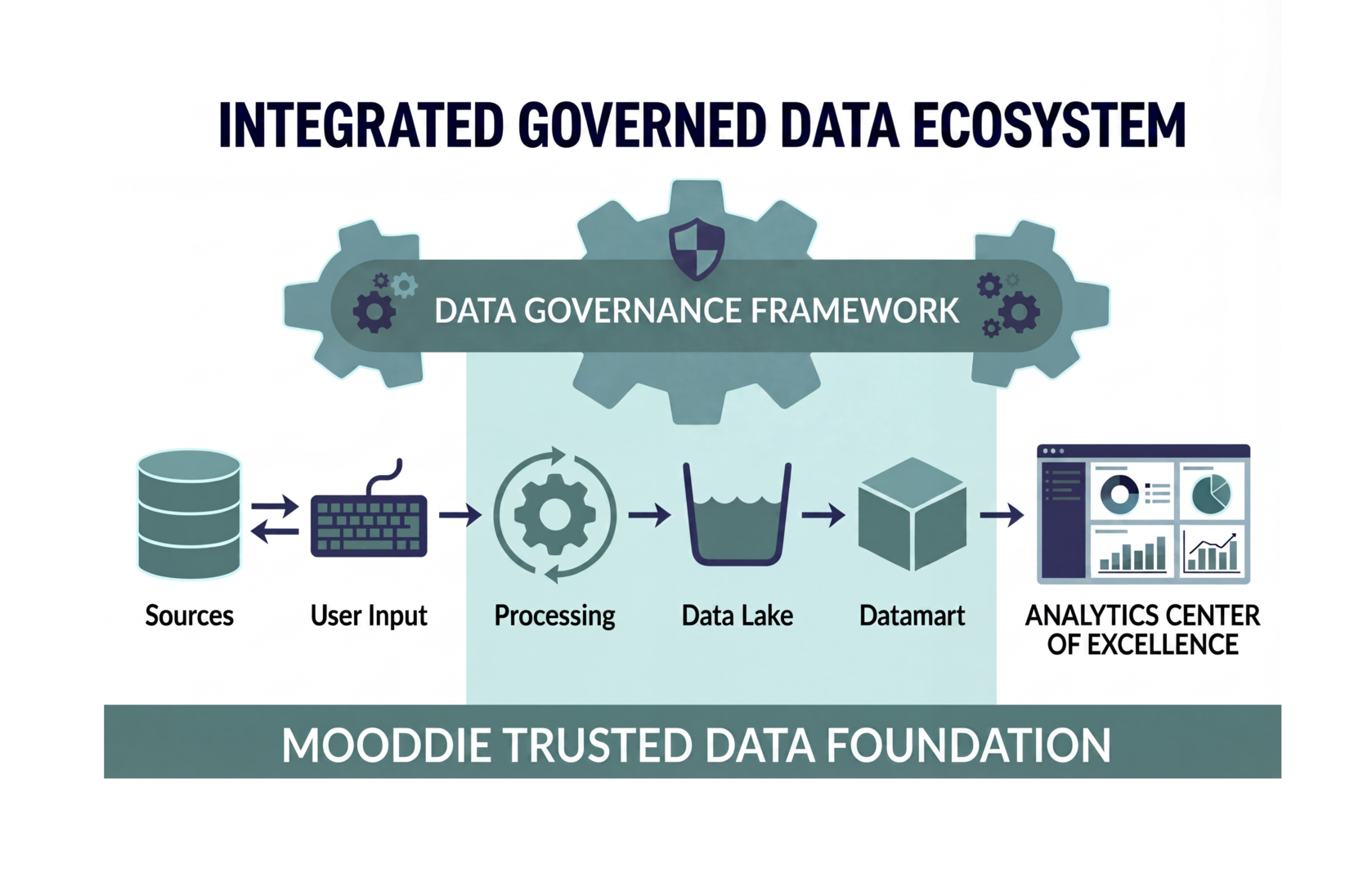
We believe that data only creates value when it is embedded in how organizations govern, decide, and take responsibility. That belief shapes our approach. We support organizations in consolidating diverse data sources into a unified data lake, but more importantly, we enable the governance structures that transform raw data into evidence, decisions, and accountable outcomes.
We work closely with leaders across the public sector, finance, and industry who are responsible for complex systems and high-impact decisions. In these contexts, the central question is no longer “Do we have dashboards?” but rather:
- Can decision-makers trust what they see?
- Can they explain how indicators are produced?
- Can they justify decisions to regulators, citizens, boards, or auditors?
This is precisely the role of the Mooddie Digital Data Framework, which delivers an informational cockpit for the organization a shared, governed decision space designed for oversight, coordination, and leadership.
Within this cockpit, data is organized not around tools, but around decisions. Operational and executive dashboards become components of a broader system that provides:
- Transparency, by making critical information visible across organizational layers;
- Traceability, by linking indicators directly to data sources, business rules, and ownership;
- Decision support, aligned with real governance cycles, not abstract analytical exercises.
The informational cockpit
Serves as a single point of reference for leaders, a place where performance, risk, compliance, sustainability, and strategic objectives can be understood together, rather than in silos. It enables consistency across the organization while respecting distributed responsibilities, a key requirement in modern governance models.
Crucially, this is not achieved through heavy investments or long, disruptive transformation programs. The cockpit is delivered pragmatically, evolving incrementally with the organization’s maturity and priorities. Governance is embedded through design, not added as an afterthought.
The result is not technology for its own sake. It is a trusted decision environment, one that supports responsible innovation, measurable sustainability, and the effective and ethical use of AI. An environment where AI can augment decisions because the underlying data is governed, explainable, and auditable.
At a time when expectations around transparency, accountability, and impact are higher than ever, governing with data is no longer optional, and is not about seeing more data. It is about creating a shared, trustworthy cockpit from which leaders can decide better and stand behind those decisions with confidence.